

Establish PMI Governance Model
How to Structure a Steering Committee, PMO, and Decision-Making Processes After an Acquisition
Related topics
What matters in the PMI Governance Model
An acquisition does not automatically create an integrated company – it creates complexity. Two system landscapes, two IT teams, two security levels, and a multitude of decisions that no one is clearly responsible for. Studies on M&A transactions have shown the same pattern for years: A significant portion of announced synergies is never realised. The causes are rarely technical. They lie in decisions being made too slowly, responsibilities remaining unclear, and IT not being represented in the decisive body.
This is precisely where governance comes in. A well-thought-out governance model determines integration success earlier than any technical migration – because it defines who decides on what and how quickly. This guide shows you how to build a viable governance model from an IT integration perspective: from staffing the steering committee and the role of the IT PMO to a RACI-based decision matrix and KPI control.
Governance for us isn't a special discipline that only appears during takeovers. It is the continuous steering layer that supports every complex change initiative – whether after an acquisition, during a system migration, or in a company-wide digitalisation. The common denominator is always the same: structuring an initiative cleanly, making it technically compatible, and steering it through to operational impact. Post-merger integration is the most demanding of these cases, because here two established organisations have to come together under time pressure.
This guide is part of our Guide to Post-M&A Business Integration and is aimed at IT leaders, CIOs, CDOs and Integration Managers who don't want to leave an acquisition to chance.
A first step for companies in the field of system integration is to know their strengths and weaknesses compared to the market.
What is a PMI Governance Model?
A PMI Governance model is the structured framework of bodies, roles, decision paths, and control mechanisms that ensures post-merger or acquisition integration proceeds in a controlled, prioritised, and transparent manner. It definitively answers three questions: Who decides? On what basis? And what happens if a decision is not made?
Differentiation from neighbouring concepts
A PMI governance model is not a project management methodology and not an IT governance framework in the traditional sense:
- Project Management (e.g., according to PMI standard) organises individual projects. Governance organises decisions. About these plans.
- IT Governance regelt den Dauerbetrieb der IT-Organisation. PMI-Governance ist temporär, hat ein Enddatum und einen klaren Zweck: die kontrollierte Zusammenführung zweier Organisationen.
- Organisational design Strategy describes the target structure. Governance describes the way to get there.
Why a PMI governance model must be conceived with IT in mind
IT is the critical bottleneck in almost every integration – and at the same time the body that is most frequently involved too late. A governance model without fixed IT representation leads to three predictable consequences: shadow projects, because business departments build their own solutions while the target architecture is still open; duplicate structures, because no one decides which system wins; and security vulnerabilities, because merged systems are operated without harmonised guidelines.
A viable model therefore anchors IT not as a supplier, but as a decision-maker at all three governance levels.
Further How to derive a concrete roadmap from the governance framework, read in our Post-merger integration strategy consulting.
The three governance levels at a glance
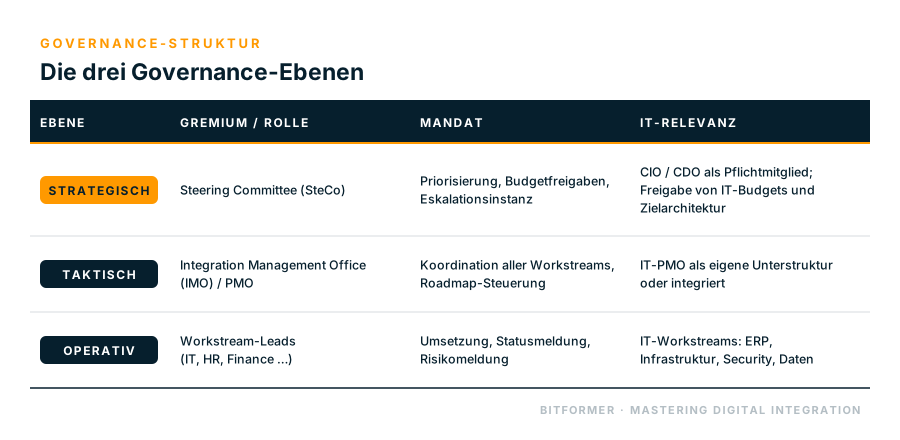
A functioning governance model operates on three clearly separated levels. Each level has its own mandate, its own rhythm, and its own IT responsibility. The separation prevents the most common governance problem: strategic issues getting lost in operational meetings – or vice versa.
Where are you in the process right now?
Wherever you are at: In 30 minutes, we will jointly sort out what decision is next and where your greatest risk lies. No pitch, no commitment – just an honest assessment.
Steering Committee: Structure, Roles, and Decision-Making Rules
The Steering Committee is the highest decision-making body for the integration. It does not meet to receive status updates, but rather to make decisions that cannot be made at a lower level.
Role
Reasoning
Chief Executive Officer / Chief Operating Officer
Escalation instance and strategic prioritisation. Without a mandated sponsor, the SteCo remains toothless.
Chief Financial Officer
Synergy tracking and budget approvals. The link between business case and integration reality.
CIO / CDO
IT architecture, security, and data strategy. IT has decision-making authority at a strategic level, not just an information-providing role.
Chromium
Organisational and HR integration, employee retention in the critical phase.
Business Unit Heads
Operational decisions with customer impact, prioritised by business relevance.
bitformer as an external M&A consultant
Methodological competence and independence – particularly valuable when internal interests clash.
The team is deliberately lean: a steering committee with more than eight to nine members loses its decision-making ability. Those who don't make decisions don't belong on the committee but on the distribution list.
The Integration Management Office (IMO) and the IT Project Management Office (PMO)
The IMO is the operational control centre for integration. In IT-driven transactions, a dedicated IT-PMO is also recommended – not as bureaucracy, but because the IT dependencies are too numerous to manage in passing.
IMO or IT-PMO – what's the difference?
Integration Management Office (IMO)
IT-PMO
Coordinates all workstreams (IT, HR, Finance, Legal...)
Focus on IT workstreams and IT dependencies
Covered by the Integration Manager
Occupied by IT Project Manager or Enterprise Architect
Report to the Steering Committee
Report to IMO and CIO
Is responsible for the entire PMI roadmap
Is responsible for the IT roadmap and Day 1 IT readiness
In smaller transactions, the IT PMO can be established as a sub-function within the IMO. As soon as the IT landscape is complex – multiple ERP instances, separate cloud environments, no common identity management – the coordination effort justifies a standalone structure.
Detailed tasks of the IT-PMO
- Coordination of IT Workstreams: ERP, Infrastructure, Security, Data and Applications
- Management of IT dependencies through a central dependency register
- IT risk register leadership and escalation
- IT budget tracking and synergy reporting to CFO and Steering Committee
- Interface management for business workstreams
The crucial point: The IT PMO is active from Day 1 – not just when the first problems become visible after closing.
Those who cannot staff this structure with their own resources do not need to build it themselves. An integration or IT PMO can also be operated externally on a temporary basis – from project and programme management, reporting, risk management and decision-making logic to the management of external service providers – and then handed over to one's own organisation in an orderly fashion at the end of the integration. This is precisely the role we take on in integration projects where the internal capacity is insufficient for a full PMO.
KPI Management: How do you measure governance success?
Governance that cannot be measured only exists on paper. The following key figures make it visible whether your structures are actually producing decisions – and not just meetings.
KPI Category
Key figure
Target value / Benchmark
Governance efficiency
Escalation rate (number of SteCos)
Fewer than 3 escalations per month
Decision-making speed
Decision-making speed
Decision duration
IT risk
Open critical IT risks
0 open P1 risks after day 30
Project Progress IT
On-time delivery of IT workstreams
> 85 % after 100 days
IT Synergies
Achieved IT cost synergies (€)
UK Business Case (monthly)
Stakeholder satisfaction
Integration NPS (internal)
50 points after day 60
Incidentally, a high escalation rate is not a sign of failure, but often of functioning governance – as long as decisions are subsequently made quickly. It becomes critical when escalations are left to linger.
Further How to robustly measure IT synergies, we delve into in our overview on Post-merger IT integration.
Common mistakes when building a PMI governance model
Governance is our discipline for integration – not just theory
Describing a governance model is one thing, making it work under time pressure is another. For us, both go hand in hand: we not only conceptualise the structure, but also staff and operate it as needed. Programme and multi-project management, the design and modification of governance structures, process and KPI design, the management of critical IT migrations up to cutover and go/no-go logic, as well as interim management for project and programme responsibility – this is the management expertise with which we support integrations from the decision phase to operational impact.
The approach remains the same at every stage: we take on as much control as necessary, build internal expertise in parallel, and ultimately hand over a viable, documented structure to your organisation.
Frequently asked questions
Are you just starting with a company integration?
Arrange initial consultation
Get your governance structure assessed for free. In a 30-minute initial consultation, we'll work together to identify the next decision to be made and where your greatest risk lies. no sales pitch, no obligation.
Together we will find out if and how I can best support you.
I look forward to exchanging with you
MAX GIESSLER
Managing Director of bitformer GmbH