



Skip to content

Defence is the best defence

IT security aims to reliably protect digital infrastructures, systems, data and end devices from technical failures, unauthorised access and cyber attacks. This is not just about protecting individual components, but about a holistic security concept.

That's why we focus on thorough needs analysis, well-thought-out concepts, and sustainable measures rather than short-term activism. Together, we are creating an IT security foundation that is convincing today and will stand the test of time tomorrow.

We rely on technologies based on artificial intelligence, collective threat analysis, and centrally controlled update and maintenance services based.

This is what we offer your company for IT security

What is IT security?

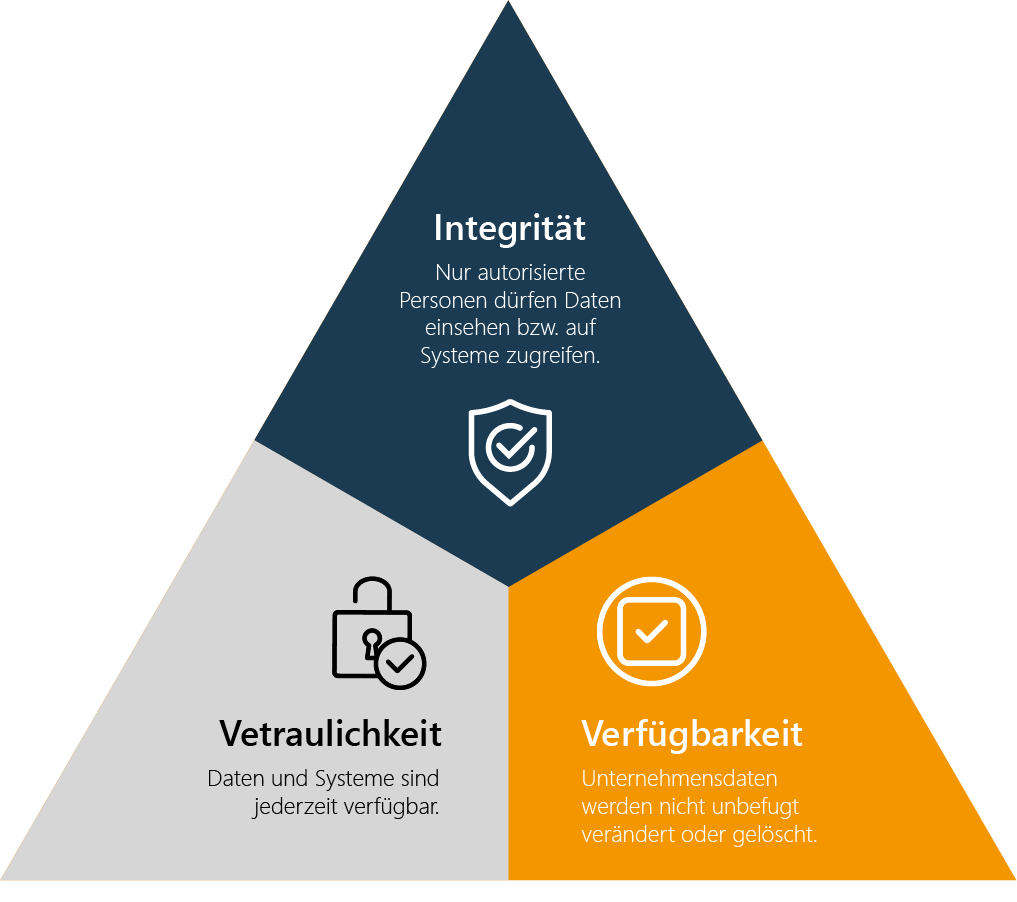
IT security refers to all measures and procedures designed to protect digital systems and data from unauthorised access, misuse, disclosure, disruption, modification, or destruction. In particular, the focus is on protecting sensitive information and ensuring confidentiality, integrity, and availability.

In an increasingly interconnected world where cyber threats are constantly evolving, a strong IT security strategy increasingly important. Companies and organisations rely on effective security measures to protect themselves from risks such as data breaches or targeted cyber attacks.

Arrange a free and non-binding consultation appointment now:

Confidentiality

With the increasing spread of the Internet of Things (IoT) in industry, protecting data now extends far beyond traditional IT systems like computers. In modern production environments, machines, sensors, and networked systems are connected to each other and continuously record operational and process data.

For example, manufacturing plants can provide detailed information about production processes, or networked sensors can monitor the condition of machines and facilities. This data is of high value to companies, as it allows conclusions to be drawn about production processes, efficiency, and even trade secrets.

Therefore, these industrial systems must also be comprehensively protected against cyber threats to prevent data misuse, sabotage or production failures.

Integrity

In IT security, integrity means that for industrial companies, data and systems remain correct, complete, and unaltered at all times.

Therefore, companies should implement measures such as access controls, checksums, digital signatures, and continuous monitoring to ensure that data is not altered unnoticed. This ensures that decisions and processes are always based on reliable information.

Firewalls act as gatekeepers, monitoring incoming and outgoing network traffic, while Wi-Fi security protocols such as WPA2 encryption offer an additional layer of defence against potential cyber threats.

Availability

Availability in IT security ensures that data and services are accessible to authorised users at all times. The use of secure routers, password managers, and two-factor authentication (2FA) mechanisms enhances availability by preventing unauthorised interruptions.

Components of IT security:

ISMS & Compliance – Systematically protecting data, IT systems and processes

The structured approach to systematically protect data, IT systems and processes – through clear rules, regular checks and continuous improvements.

Find out more.

Cybersecurity – Protecting your systems, networks and data from digital attacks from the internet

Cybersecurity encompasses all measures taken to protect systems, networks, and data from digital attacks from the internet.

These include firewalls, encryption technologies, and regular security updates, among others.

A very important aspect is also user awareness to avoid phishing attacks and unsafe behaviour.

Effective protection can only be guaranteed through a combination of technical security and responsible action.

Find out more.

Network Security – Protecting Your Business Network from unauthorised access, attacks, and data loss

Network security encompasses all measures that protect a company network from unauthorised access, attacks, and data loss. This includes the use of firewalls, intrusion detection systems, and secure access controls. Regular updates, network monitoring, and the segmentation of sensitive areas are equally important. Only through a holistic security strategy can a stable and protected network be guaranteed.

Find out more.

Backup & Recovery – Regular data backup

Backup & Recovery involves regularly backing up data to ensure operational readiness in the event of loss, cyber-attacks, or system failures. Automated backups and clearly defined recovery processes enable companies to significantly reduce downtime. Modern solutions are increasingly relying on scalable storage concepts that can be flexibly adapted to requirements. With the Private or hybrid cloud solution From Bitformer! companies receive a secure and high-performance service for reliable data backup and fast recovery.

Find out more.

IT Security in the Home Office – Accessing Company Data and Systems Securely

When working remotely or from home, IT security is crucial for secure access to company data and systems.

The use of VPN connections, secure passwords, and two-factor authentication protects against unauthorised access.

Equally important are regular updates, as well as the use of trusted networks and devices.

Clear security guidelines and employee awareness significantly reduce the risk of cyberattacks.

Find out more.

EXTERNAL ISB – if you don't want to build up specialist expertise internally

An Information Security Officer (ISO) is responsible for planning, implementing, and monitoring information security within a company. They ensure that legal requirements and security standards are adhered to and that risks are identified early on.

An Information Security Officer (ISO) is not a general legal requirement for every company in Germany. However, an obligation arises if companies fall under certain regulatory requirements, for example, as operators of critical infrastructures (KRITIS) or within the scope of standards such as ISO 27001, if these are mandatorily required. Industry-specific requirements, for example in the financial or healthcare sectors, can also necessitate the appointment of an ISB. Regardless of any legal obligation, an ISB is nonetheless sensible for many companies to systematically manage information security and minimise risks.

With our external ISB service offering, you can demonstrate an ISB without having to build or tie up internal resources. This allows you to benefit from specialised expertise and professional support for your information security.

Find out more.

The term IT security is often mistakenly with Information Security or Cybersecurity equated, although there are differences: While information security focuses on the protection of information itself, IT security centres on securing technical systems. Information is the actual asset and exists independently of IT systems or cyberspace, which is why it must be protected in all its forms.

 IT security hingegen relates to the protection of the underlying infrastructure, such as computers, servers, cloud services, and networks. These systems must be protected from unauthorised access, as they enable the processing and exchange of information.

Network security

Network security refers to all measures aimed at protecting networks and the data processed and stored within them in terms of confidentiality, integrity, and availability. The focus is not only on fending off unauthorised access but also on ensuring that authorised users can smoothly access the resources they need at all times. This is achieved through the use of various technologies, security policies, and control mechanisms that prevent attacks, detect anomalies, and safeguard the entire network infrastructure.

YOUR CONTACT PERSON

Connect with our expert.
Non-binding, uncomplicated, but always with
added value for you.

RALPH DÖRFLER

Head of IT Security